

As a global leader in filtration technology with over 10 years of manufacturing experience, we've seen how a prematurely clogged fuel filter can paralyze a heavy-duty fleet or industrial generator.
If you are replacing filters more often than the standard 15,000 to 30,000 miles (25,000 - 50,000 km) interval, you aren't just facing a maintenance issue-you have a systemic problem. Here are the 7 most common reasons for frequent fuel filter clogging in 2026.
1. Low-Quality Fuel (The "Dirty Tank" Syndrome)
The most common culprit isn't the filter; it's the source. In many regions, fuel storage tanks at stations may contain sediment, rust, or debris.
The Science: Particulates as small as 5-10 microns (invisible to the naked eye) can saturate a standard cellulose filter membrane quickly.
Solution: Use a pre-filter or a fuel water separator with a clear bowl to monitor incoming fuel quality.
2. Microbial Contamination (Fuel "Algae")
In diesel systems, especially those using Biodiesel blends, bacteria and fungi can grow in the water-fuel interface.
The Symptom: A slimy, black, or green sludge covering the filter media.
Solution: Implement a biocide treatment and ensure your storage tanks are regularly drained of water.
3. Fuel Tank Corrosion
Internal rusting of aging steel fuel tanks releases oxidized metal flakes directly into the fuel line.
Insight: Even a small amount of moisture can trigger oxidation in a half-empty tank due to condensation.
Solution: Inspect the internal lining of your fuel tanks or switch to high-density polyethylene (HDPE) tanks.
4. Cold Weather "Gelling" (Paraffin Wax)
In temperatures below 0°C (32°F), paraffin wax in diesel begins to crystallize, creating a "cloud" that blocks the filter pores.
Tech Tip: This is often mistaken for a "dirty" filter when it is actually a temperature-flow issue.
Solution: Use winter-grade fuel additives or install a fuel heater kit.
5. Incompatible Filter Media (Cellulose vs. Synthetic)
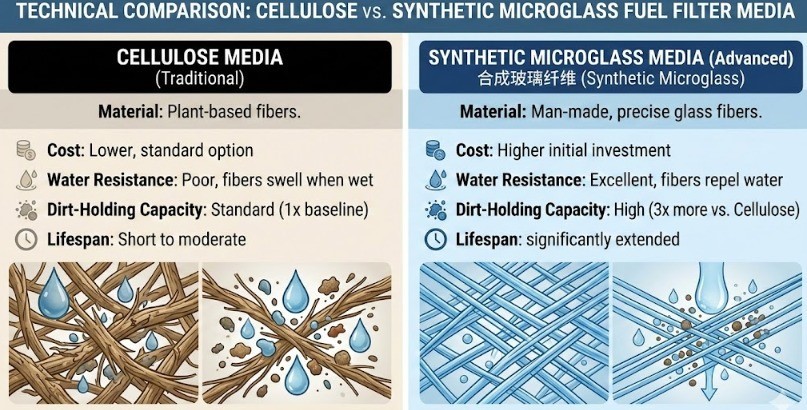
Using a 2-micron filter where a 10-micron filter is specified will cause the filter to clog almost immediately because it is "too efficient" for the system's debris load.
Comparison: * Cellulose: Traditional, cheaper, but swells when wet.
Synthetic Microglass: 3x the dirt-holding capacity and better water resistance.
6. Damaged or Failing Fuel Pump
A wearing fuel pump can shed tiny metallic particles (shrapnel) into the fuel stream.
Warning Sign: If you find shiny metallic glitter in the pleats of your used filter, your pump is failing.
7. High Bio-Content in Modern Fuels
Modern "Green Diesel" contains higher percentages of fatty acid methyl esters (FAME). While eco-friendly, these act as a solvent, cleaning out old gunk from your fuel lines and sending it all to the filter at once.
🛠 Pro-Talk: Expert Maintenance Tips for 2026
"Don't just change the filter; analyze the 'Crime Scene'."
When you remove a clogged filter, cut it open. If the pleats are wavy, you have a water problem. If they are covered in hard black carbon, you have a soot/exhaust gas recirculation issue.
FAQ
Q: What are the signs of a clogged fuel filter?
A: Common symptoms include engine hesitating under load, decreased fuel efficiency, stalling at idle, and the "Check Engine" light triggered by a lean fuel mixture.
Q: Can I clean and reuse a fuel filter?
A: No. Modern high-efficiency fuel filters use depth-loading media. Once the internal pores are saturated, surface cleaning cannot restore the flow rate. Always replace it with an OEM-spec filter.
Q: Does frequent idling cause clogging?
A: Indirectly, yes. Excessive idling can lead to incomplete combustion and higher moisture levels in the system, which promotes microbial growth and sediment buildup.

